This week, students throughout the country received their A level grades and began the process of figuring out the implications for further study or entering the labour market. This analysis explores the policy background, before examining what we can see in the 2019 statistics on entries and attainment.
Policy context
This year marks the penultimate stage in the rollout of the new A level qualifications, introduced incrementally from 2016. Students getting their grades today were the first to take the new A level courses in maths, political studies, and many other subjects. The new A levels included changes in both content and assessment methods, with the aim of better preparing students for further study.
A level content was updated in line with recommendations from the higher education sector. Changes included incorporating more quantitative skills in psychology and economics and learning how to work with large datasets in mathematics.
The format of assessment was also changed. Exams are now at the end of A level courses, rather than throughout the year. Coursework was minimised and was only included when it was an essential part of assessing certain skills, such as in science practicals. Except for art and design subjects, coursework forms a maximum of 20 per cent of the A level grade.
AS levels, which students used to take in the first half of their A levels, are now a standalone qualification, worth 40 per cent of an A level in UCAS tariffs. They do not count in the A level offers universities make to students. As a result, there has been a steep decline in AS-levels since 2015, detailed below.
18-year-olds getting their results today were also the first to sit the new, more challenging, GCSEs in English and maths. These reforms led to concerns in some quarters that students might be “put off” from taking these subjects at A level.
Entry rates
A level entries have increased as a proportion of 18-year-olds While there has been a 1.2 per cent decline in the number of A level entries compared to last year (1.0 per cent lower for males and 1.3 per cent lower for females) this is against a fall of 2.1 per cent in the overall 18-year-old population.
Entries from sixth form and further education (FE) colleges have fallen more sharply, by 6 per cent. Given that disadvantaged pupils are more likely to study at these colleges, these students may now be following a narrower curriculum. These institutions have also been feeling the effects of funding pressures, with real terms per student funding falling by 16 per cent over the last decade, with FE colleges the hardest hit
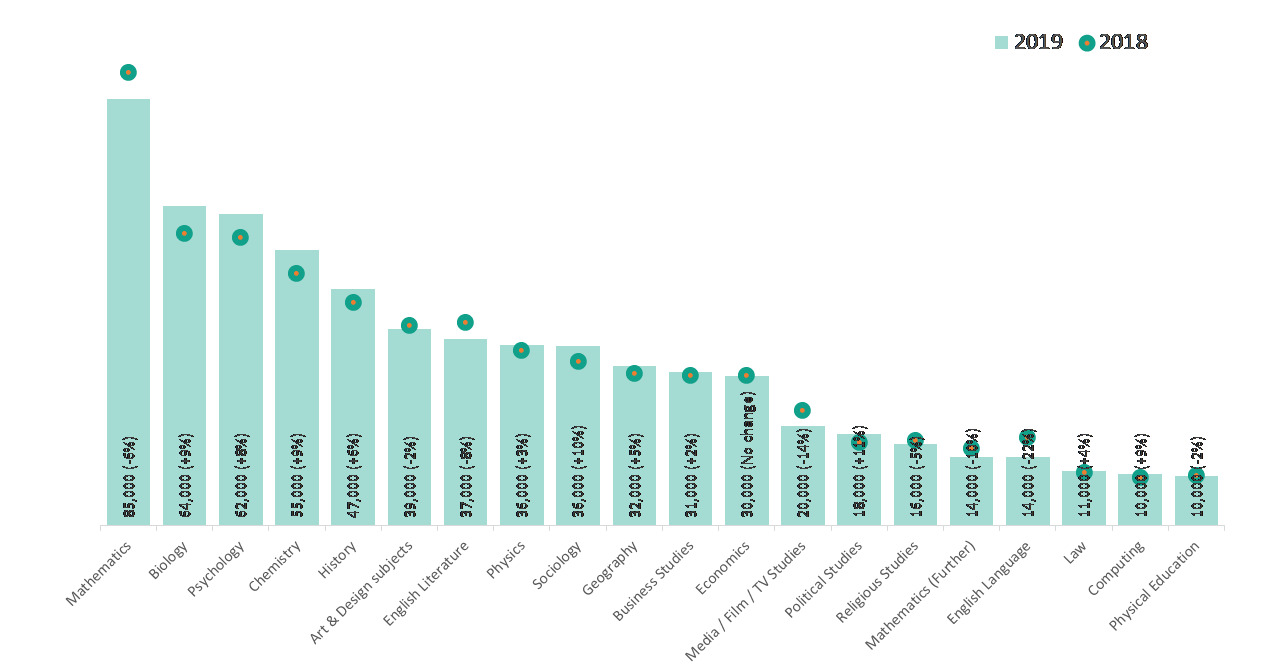
In terms of individual subjects, social sciences are on the rise, with political studies, psychology, and sociology seeing some of the biggest increases. Also popular are the science subjects; entry to chemistry and biology have risen by around nine per cent each. Overall, natural sciences, social sciences, and maths make up just over half of entries. Some of the largest declines were in English language, performing arts, and media studies, which fell by 22 per cent, 18 per cent and 14 per cent, respectively.
As outlined above, these A level students are the first cohort to have taken the reformed GCSEs in English and maths, and entry data shows a drop in the popularity of these subjects. English literature continues its decline, with an 8.1 per cent decrease on last year’s figures and mathematics also sees a dip of 5.8 per cent, having previously been on the rise (Figure 1). The government will hope that the recently announced maths premium, which offers schools extra funding for pupils studying mathematics A level, will boost numbers up again. Overall, these trends suggest that harder GCSEs could be putting children off continuing with English and maths, and the pattern could continue for other subjects affected by the GCSE reforms.
Figure 1: Number of entries per subject in 2018 and 2019