The teacher labour market is subject to a high level of churn. In 2016, around 50,000 teachers left their jobs in state-funded schools in England, to be replaced by around 50,000 new entrants. That makes for about 1 in 10 teachers replaced by a new one each year. This is before we account for the further 8 per cent of teachers who move school each year. In this analysis, we examine some of the acute challenges facing the teacher labour market, the evidence of any impact this is having on schools and pupils, and the options for policymakers to mitigate the problems.
The Challenges
Between 2016 and 2026, the overall number of pupils is expected to grow by 11 per cent, with much faster growth in secondary schools (20 per cent) than in primary schools (4 per cent). To prevent class sizes from rising, the total number of teachers would also need to grow by a similar amount, with new entrants exceeding exits, rather than equalling them as they do at present.
There are some further challenges in secondary schools. The government has set the ambition for 90 per cent of GCSE pupils to be entered into the English Baccalaureate (EBacc) by 2025, as compared with 38 per cent at present. To be entered into the EBacc, GCSE students must be taking subjects that include English language/literature, maths, sciences, geography/history and a language. Some rise in EBacc entry rates could be accommodated for by filling empty seats in some lessons, but increasing take-up from 38 per cent to 90 per cent will require a significant rise in the number of teachers able to teach these subjects. For example, EPI analysis has suggested that the number of modern foreign languages teachers would need to increase by 78 per cent in 2019–20 in order to meet government targets.
State of the teacher labour market
Unfortunately, there have been some worrying signals from the teacher labour market. First, exit rates have been creeping up over time. Between 2010 and 2016, exit rates increased from around 8 per cent to 9 per cent in primary schools and from 9.5 per cent to 10.5 per cent in secondary schools. Even more concerning is the increase in the number of teachers choosing to cut short their teaching careers, with around 80 per cent of exits in 2016 due to movements to other jobs or outside the state-funded sector in England as compared with around two thirds in 2010. Exits also appear to be concentrated early in teachers’ careers, with only 60 per cent of teachers working in a state-funded school in England five years after starting training. This 5-year retention rate is only 50 per cent for high-priority subjects like physics and maths.
Second, there are also worrying signs on entrants. Recent figures suggest applications to teacher training are down by around 30 per cent compared with previous years. However, history shows that only about two thirds of these applications tend to translate into entrants into teacher training each year, as some applicants do not get any offers or withdraw their applications. This means there is still a chance training providers will be able to get close to meeting DfE’s recruitment targets, but they might need to accept nearly all applicants. These figures therefore send a worrying signal on both the quantity of trainees, and potentially their quality too.
The problem also looks worse in secondary schools. In 2017–18, training providers managed to fill targets for number of primary school teacher trainees. However, only about 80 per cent of targets were filled for secondary school trainees. In some EBacc subjects, such as physics, these targets have been persistently missed over time. For example, in 2017–18 only about 80 per cent of training placement targets were filled in maths, chemistry and geography, whilst in physics it was only 70 per cent.
Impact on schools and pupils
What evidence is there that these trends are starting to impact on schools and pupils? At a macro level, the ratio of pupils to teachers has barely increased at all. It remained around 21 pupils per teacher in primary schools between 2011 and 2016, and only increased from 15.6 to 16.4 in secondary schools.
The evidence also suggests that the number of hours taught by subject have (mostly) responded in a predictable manner to the introduction of the EBacc and other changes to school accountability. NfER have shown that total secondary school curriculum hours have increased in English, maths, history and geography, and fallen in the arts, technology, PE and other subjects. A little bit more surprising is the lack of change in science hours and a fall in hours spent teaching languages.
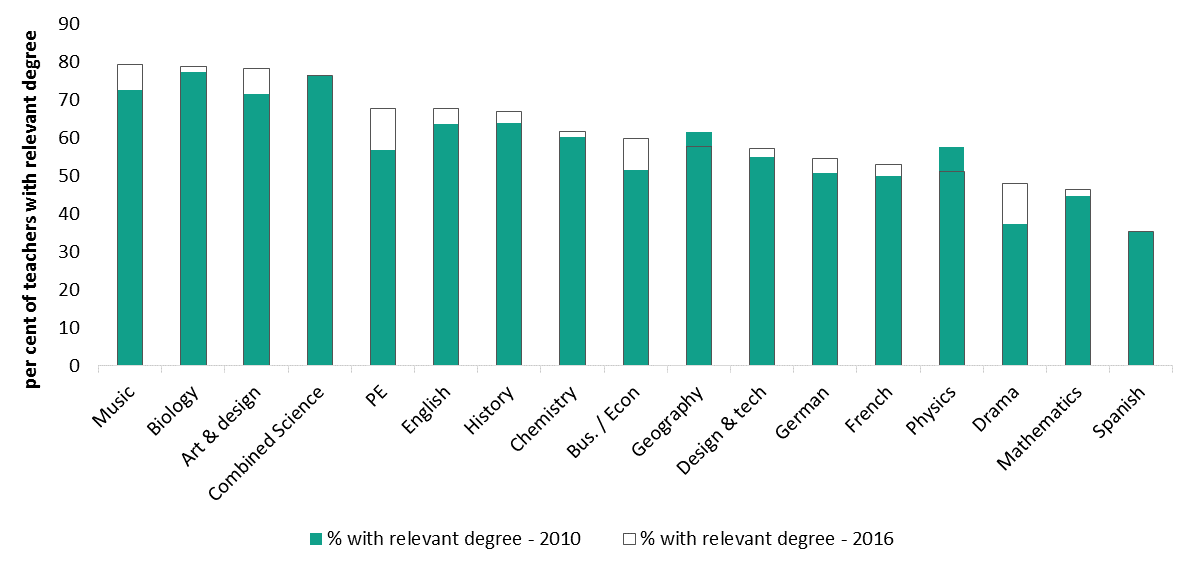
Given the increases in exits and the persistent recruitment problems in particular subjects, how have schools managed to square the circle? One way is simply by increasing teacher hours, which as recent work by NfER has shown, have been increasing over time. Second, in some subjects, schools have been relying on staff with lower qualifications. The figure below shows the proportion of teachers with degree-level or higher qualifications in the subject they teach. Encouragingly, the proportion of teachers with a relevant degree has increased over time across most subjects. However, there is quite a lot of variation. In many non-EBacc subjects, the proportion of teachers with a degree in that subject has risen over time, for example in music, arts, drama, PE and business/economics, which makes sense as schools can be more selective in their hires. In EBacc subjects, there is a bit of a mixed picture, with broadly steady levels or slight rises in maths, English, chemistry, biology, languages and history. The two subjects where there has been decline are physics and geography, both EBacc subjects and where recruitment targets have been missed over time.
The absolute differences across subjects are also very revealing. In some subjects, two thirds or more of present teachers have a degree-level qualification or higher, e.g. Biology (79 per cent), Art (78 per cent), PE (68 per cent), English (68 per cent) and History (67 per cent). Whilst in others, around half or less have a degree-level qualification, e.g. German (55 per cent), French (53 per cent), Physics (51 per cent), Maths (46 per cent) and Spanish (35 per cent). These substantial differences result from long-term differences in the ability of schools to recruit and retain teachers with degrees in different subjects, and also relate quite strongly to the known differences in graduate earnings by subject e.g. maths and physics graduates tend to earn more than graduates in English, biology and the arts.