Earlier this month the Prime Minister outlined a commitment to guarantee an apprenticeship for all eligible young people in the new academic year.
While further details on the guarantee are yet to be published, it is clear that beginning an apprenticeship will become an increasingly attractive prospect for education leavers who might otherwise have entered directly into employment at the onset of a recession.
As well as further developing their skills, delaying their search for employment by taking up an apprenticeship may also help to fend off the long-term scarring effects experienced by those who go directly from education into unemployment.
Ordinarily, a large number of young people decide to enter straight into work after completing their GCSEs. Statistics published today by the Department for Education show that prior to the Covid-19 pandemic, at the end of 2019, as many as one in ten young people aged 16-18 (over 200,000) were employed or in employer-funded training.
But as employment may no longer be an option for many school leavers this year, the proportion of young people seeking an apprenticeship or opting to stay in full time education when they may otherwise have found employment, could be set to rise considerably.
The key question now is, in a time of high unemployment, especially in the sectors traditionally popular for young people, how can the government ensure employers take apprentices on?
Keeping these young people in full-time education is the obvious alternative. But even here there are many challenges. For example, the issue of whether colleges and teachers have the capacity to accommodate a large influx of students, a problem which may be amplified by policies designed to raise the basic numeracy and literacy of young people in education.
There is currently a requirement for those in full-time post 16 education to continue English and maths study if they have not achieved at least a pass in these subjects at GCSE (a grade 4), with colleges who then take on these students held accountable for improving their grades.
Those who achieved slightly below a pass grade at GCSE (a grade 3) must continue to study towards an English and maths GCSE, whilst those who achieved lower grades, or those taking an apprenticeship, must usually study towards separate Functional Skills qualifications. There is some flexibility in this policy, with colleges able to exempt up to 5 per cent of students from continuing their GCSEs. However, against the backdrop of rising unemployment, the number of students who may return to further education, and therefore fall newly within this requirement to continue English and maths study, is set to increase significantly.
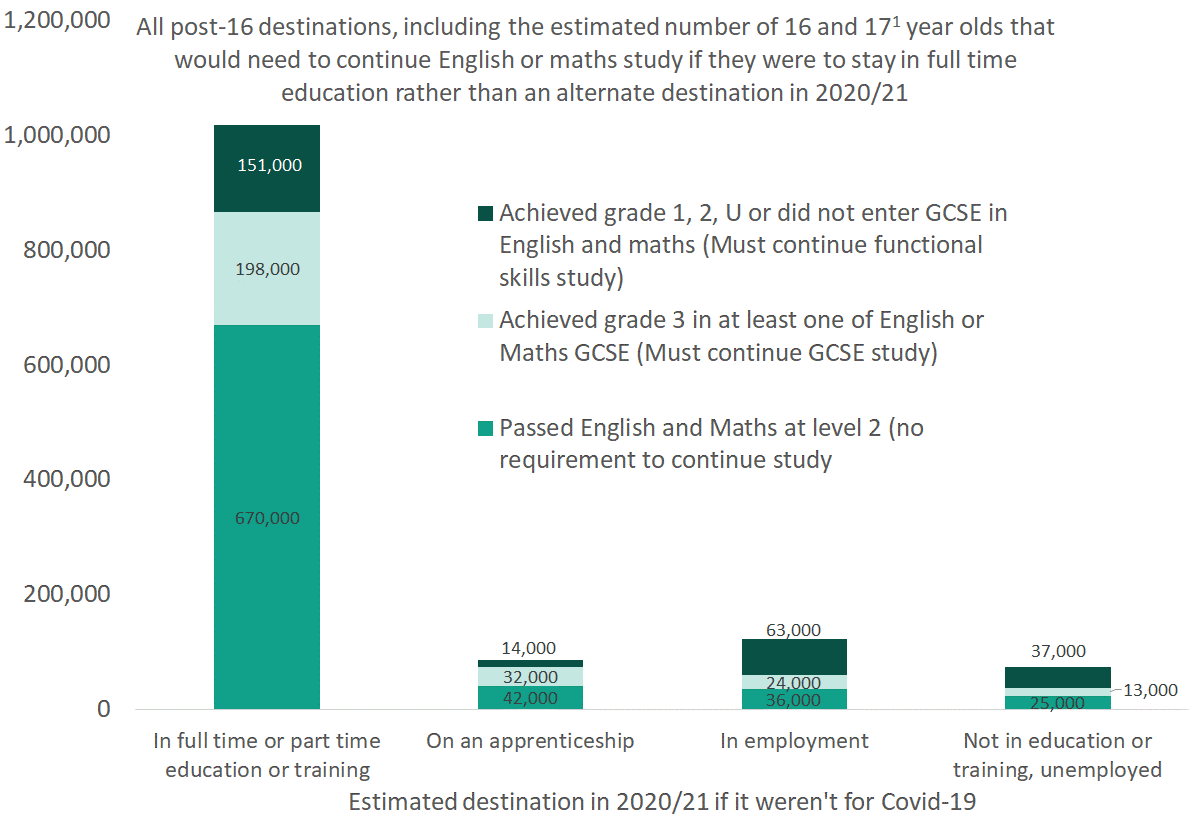
EPI analysis indicates that, this coming year, there may be around 123,000 16- or 17-year olds who would normally find employment, of which more than two thirds won’t have passed English and maths. This means that if these young people did opt to come back to the education system to avoid unemployment, most would be required to continue to study these subjects.
Of those that did opt to return to education and would be required to continue English or maths study, around a quarter would need to work towards securing a pass in GCSE rather than taking separate Functional Skills qualifications. Furthermore, if young people actually find it harder rather than easier to find an apprenticeship, although not all would return to full time education, there could be up to another additional 32,000 students facing GCSE study.
In a typical year, around 100,000 16-18-year olds would study towards an English resit qualification, and nearly 150,000 study towards a maths resit qualification. However, following a surge in numbers, in the most extreme case, there could be an additional 119,000 thousand 16- or 17-year olds required to continue with these subjects next year. Even if only half of those in other routes returned to education, this could still mean there would be nearly 60,000 extra students.
_________________________________________________________________________________________________________________