The National institute of Economic and Social Research and the Education Policy Institute have recently published research on the recruitment and retention of senior school leaders, commissioned by the National Academy for Educational Leadership Wales. Below, we summarise some of the EPI team’s headline findings on the recruitment difficulties facing Welsh schools.
Recruiting school leaders in Wales, and across the UK, can be difficult. As the job of senior leadership becomes less attractive, there is a shrinking pipeline of middle leaders progressing to senior leadership and headship, which risks creating a shortage of senior leaders. Fewer middle leaders are aspiring to become senior leaders, and more teachers are leaving the profession following the Covid-19 pandemic. In one study of headteachers in Wales, over 60 per cent reported stress levels that are associated with a negative effect on one’s health.
Wales has particular challenges both because schools can teach in either Welsh or English, and because of the geography of the country. Finding Welsh speakers to lead schools further narrows the pool of potential applicants. There are also very rural regions in Wales that can struggle to attract applicants, simply because there are fewer people living nearby.
Is there a shortage of senior leaders?
Measuring shortages of senior leaders, and particularly headteachers, is not straightforward. A shortage could mean several things: it could mean there are fewer applicants than there are vacancies. Alternatively, a shortage could occur if the applicants are not suitable for the role, perhaps because they don’t have the right skills. However, candidates may still be appointed into the role if the school has no good alternative.
To understand the nature of shortages for advertised leadership posts at schools in Wales we measured recruitment on two dimensions:
- Quantity: the average number of applicants per vacancy quantifies the size of the applicant pool.
- Suitability: the percentage of vacancies that remained unfilled after being advertised quantifies the suitability of the applicants. If the applicants are weaker, it is less likely the advertised posts will be filled.
These two measures are likely to be related because having many applicants increases the probability of finding a good leader within the pool; however, they still appear to be measuring slightly different dimensions of recruitment.
Shortages in senior leadership recruitment over the past 15 years
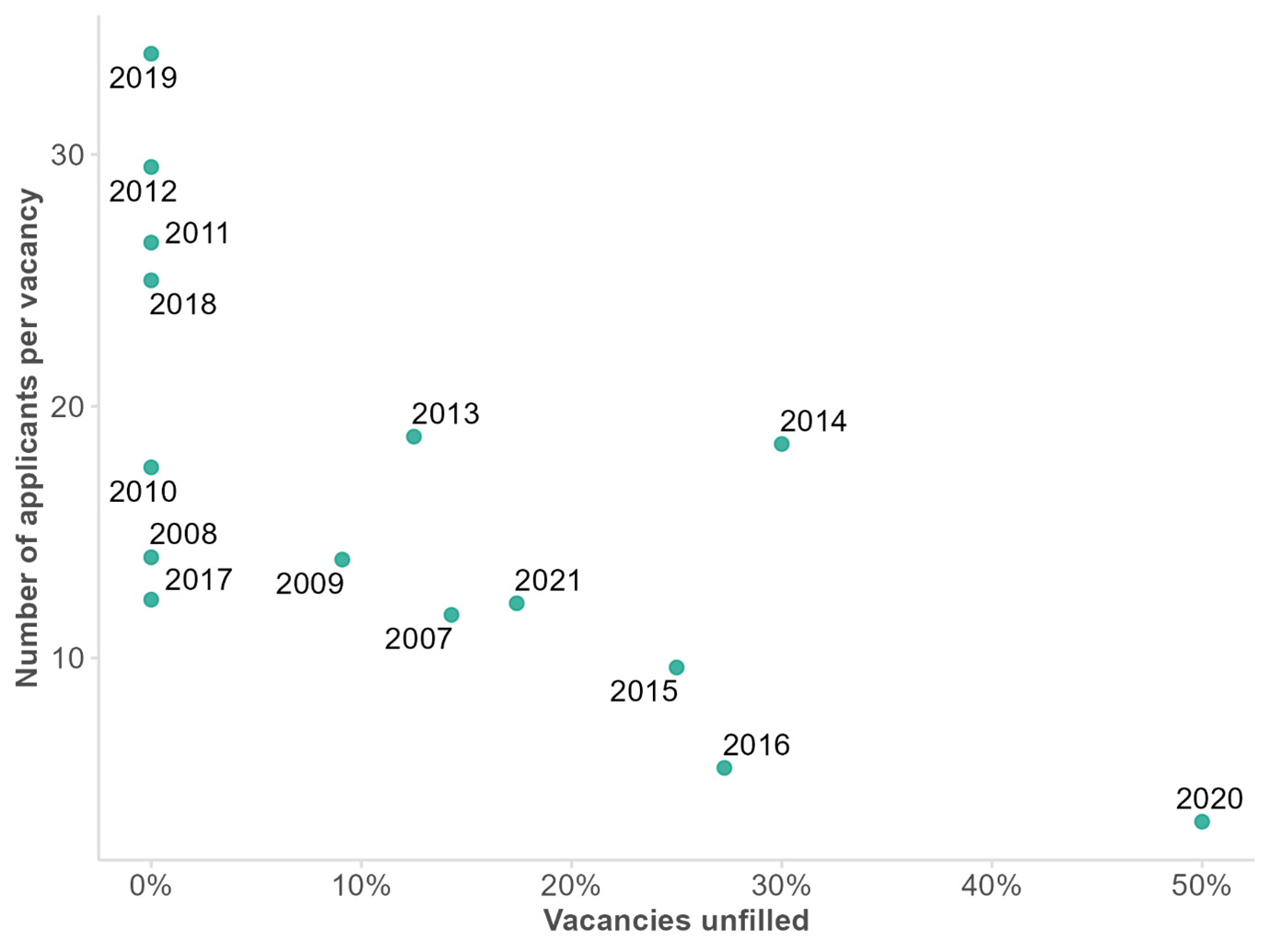
The chart below shows these two measures, calculated for all middle and secondary schools in Wales for each of the past 15 years. Across those years, there were only four in which there were a good number of suitable candidates: 2011, 2012, 2018 and 2019. The chart illustrates the importance of attracting a sizeable number of applicants for filling posts. However, it also shows that there are years (eg 2014) where, despite a considerable number of candidates, schools struggled to fill some of their vacancies. That suggests the pool of applicants might not have been as strong in those years as schools would like.
In the last 15 years, there were only four years in which there were a good number of acceptable candidates