Today the Education Policy Institute has published its official submission to the House of Commons Education Select Committee inquiry on primary assessment. The inquiry examines:
- The purpose of primary assessment and how well the current system meets this
- The advantages and disadvantages of assessing pupils at primary school
- How the most recent reforms have affected teaching and learning
- Logistics and delivery of the SATs
- Training and support needed for teachers and senior leaders to design and implement effective assessment systems
- Next steps following the most recent reforms to primary assessment
You can read the submission in full below, or download a PDF version here.
Select Committee inquiry on Primary Assessment – Education Policy Institute response
Summary of submission
We have focused on three areas of the inquiry:
- The purposes of primary assessment;
- How well the current system meets these purposes; and
- Next steps following the recent reforms to primary assessment
The purpose of primary assessment
- The Education Policy Institute considers that there are three objectives in formally assessing pupils at the beginning and end of primary.
Formative assessment
- Attainment in the early years and at primary school is particularly important for disadvantaged pupils because we know that how well children do in their early and formative years can have a lasting effect. The Education Policy Institute’s Annual Report found that, by the end of secondary school, disadvantaged pupils are on average, 19 months behind their more affluent peers. But, crucially, the majority of the gap (60 per cent) between the most disadvantaged pupils and the rest had developed by the end of primary and 40 per cent of the gap was there before children started Key Stage 1. These stark findings highlight the need to identify pupils who are at risk of falling behind, diagnose them and intervene early on.
- Teacher assessment is of course already widely used for these purposes and can help to support a child’s learning and development. But relying solely on unmoderated teacher assessment poses a risk of unconscious bias, particularly towards disadvantaged pupils. Research[1]published by Simon Burgess found that gender and class stereotypes can affect teacher assessments. His study found that, compared with national test scores, girls were over-assessed in English and under-assessed in maths. He also found that pupils on free school meals were consistently under-assessed by teachers compared with how well they achieved in national tests. In other words, ‘poor pupils systematically and significantly out-performed what their teachers thought they would achieve’.
- And so the overriding purpose of assessment in education ought to be to give teachers and school leaders an understanding of each child’s attainment and progress so that they, in turn, can identify issues or delays (or, indeed, children who are working well above ‘expected standards’) and put in place effective and proven strategies to support that child.
- This is particularly the case when considering the transition from primary to secondary school. For most secondary schools, their Year 7 intake will be unknown to them and this will be particularly the case for those with a large number of feeder primary schools. This means that it is important for secondary school teachers to have a robust and consistent assessment of a pupil’s attainment on entering the school, and for such assessment to be nationally consistent given the relatively large and varied catchment areas from which secondary schools draw their pupils.
Accountability
- Implemented correctly and proportionately, assessment outcomes can provide helpful data that should contribute to judgements about a school’s overall performance. Once again, unmoderated teacher-assessment (while valuable in many contexts) will inevitably vary from school to school. It cannot give a reliable national, or indeed local, comparison of how well a school is supporting children to progress from one phase to another.
- The Key Stage 2 National Curriculum assessments are high-stake tests. If a school fails to meet government standards, it could be faced with intervention from either Ofsted or the Regional Schools Commissioner. This could result in the school facing intervention by its local authority or being forced to become an academy (if it is an LA maintained school) or, being transferred to a different Trust if it is already an academy.
Funding
- At present, local authorities can target funding (from the Dedicated Schools Grant) to pupils who have failed to meet certain benchmarks at the end of Reception and / or at the end of Key Stage 2. For pupils who have failed to meet the specified benchmarks at the end of Reception, additional money may be given to the infant or primary school and, for those who fail to meet the end of Key Stage 2 benchmarks, additional money may be given to their secondary, all-through or middle school (depending on which school the pupil(s) go on to attend). The purpose of this is to provide schools with adequate funding to support children who are ‘falling behind’.
- Under the current funding system, local authorities (via their School Forums) have the discretion to decide whether to target funding to schools on the basis of prior attainment and the quantum of any funding that is targeted in this way. The Department for Education is currently consulting on a new national funding formula for schools[2]and their latest proposals would mean that this funding would be calculated by the Department for Education, rather than the relevant local authority.
How well does the current system meet these purposes?
- The EPI’s view is that the current system could be strengthened to support better all of the purposes set out above
Formative Assessment challenges
11. Effective formative assessments require teachers to understand how much progress pupils have made over time and in comparison to their peers. This, in turn, requires a reliable baseline assessment. According to the DfE’s own research[3], many schools are already using baseline or ‘on entry’ assessments of some kind to identify the needs of children on entry to the primary school.
12. The Department for Education has recently had to abandon plans to roll-out new reception baseline tests. These tests were designed to provide an assessment of children on entry to primary school in order to identify any emerging needs as well as to judge the progress made by pupils from the beginning to the end of primary schools (and then hold schools to account if pupils did not make the expected levels of progress). But in April of this year, Ministers dropped plans to use the Reception baseline as the ‘starting point’ for the progress measure following a study[4]which found that the three baseline tests being piloted were not comparable with one another.
13. As a result, Key Stage 1 tests will continue to be used as the starting point to measure pupils’ progress over the course of primary school. In addition, the Early Years Foundation Stage Profile (EYFS), which is a teacher assessment and takes place over the spring term in a pupil’s reception year, will remain statutory up to and including the 2017-18 academic year. It is unclear what will happen beyond that point, but the Secretary of State has said that she will launch a consultation on primary assessment early in the new year.
Accountability and Funding Challenges
The differences between the old National Curriculum Levels measure and the new ‘expected standards’
14. The new ‘expected standard’ in Key Stage 2 assessments is intended to be equivalent to a Level 4b under the old National Curriculum levels. While, prior to 2015, floor standards were set based on the proportion of pupils achieving a Level 4 or higher, in practice, it has been more commonly asserted that the sub-level 4b (the middle third of those achieving Level 4) is a more valid predictor of secondary success, and this has formed the basis for the Government’s reforms.[5]
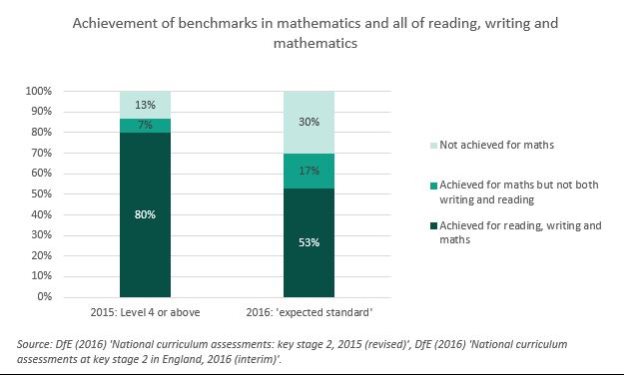
15. In 2016,53 per cent of pupils in English schools achieved the expected standard in all of reading, writing and mathematics. In 2015, 80 per cent achieved a Level 4 in Key Stage 2 assessments under the old National Curriculum system – a 27 percentage point-higher figure. The proportion achieving Level 4b in 2015 for reaching, writing and mathematics was reported by the DfE as 69 per cent. Because writing is not broken down into sub-levels, the 69 per cent includes those who achieved a Level 4b in reading and maths, but all of those who achieved a Level 4 in writing. The Education Policy Institute’s Annual Report estimated that the true proportion of pupils achieving a Level 4b across all three subjects was likely to be around 59 per cent in 2015 – 6 percentage points higher than the proportion reaching the Government’s expected standard in 2016.[6]
16. Given the difficulty of comparing figures, and the fact that this is the first year of these assessments, it is difficult to say at this stage whether the new standards are consistent or not with the previous Level 4b, but the shift is of the expected magnitude. Our Annual Report set a proposed goal for 85 per cent pupils to achieve what was a Level 4b by 2025. This would put us on track to ensure that the majority begin secondary school with the skills required to go on to succeed in their GCSEs, putting England among the highest performing developed countries by 2030.
17. However you look at it, the scale of the challenge is clear: these figures suggest that over a quarter of a million pupils not reaching the Government’s expected standard in reading, writing and mathematics.
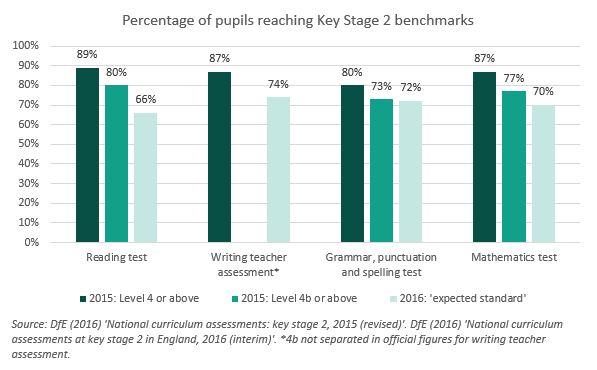
18. Unsurprisingly, as the graph below shows, the reduction in the number of pupils achieving the overall respective benchmarks between 2015 and 2016 is reflected in changes in each of the subjects assessed.
19. The most interesting pattern is that only 66 per cent of pupils achieved the reading test threshold, lower than for the other subjects. As noted in the DfE’s statistical release[7], the new results reverse the pattern of recent years of reading having the highest proportion reaching the standard benchmark among reading, writing and mathematics.
20. In comparison, the proportion reaching the expected standard in the new grammar, punctuation and spelling test was only 8 percentage points lower than the proportion achieving the old Level 4 in 2015.
21. It is not possible to discern how far this change in pattern is a result of a conscious policy decision by the Department to encourage schools to focus more on reading than previously, or an unexpected outcome of the way the assessments have played out in practice between externally marked exams and teacher assessments.