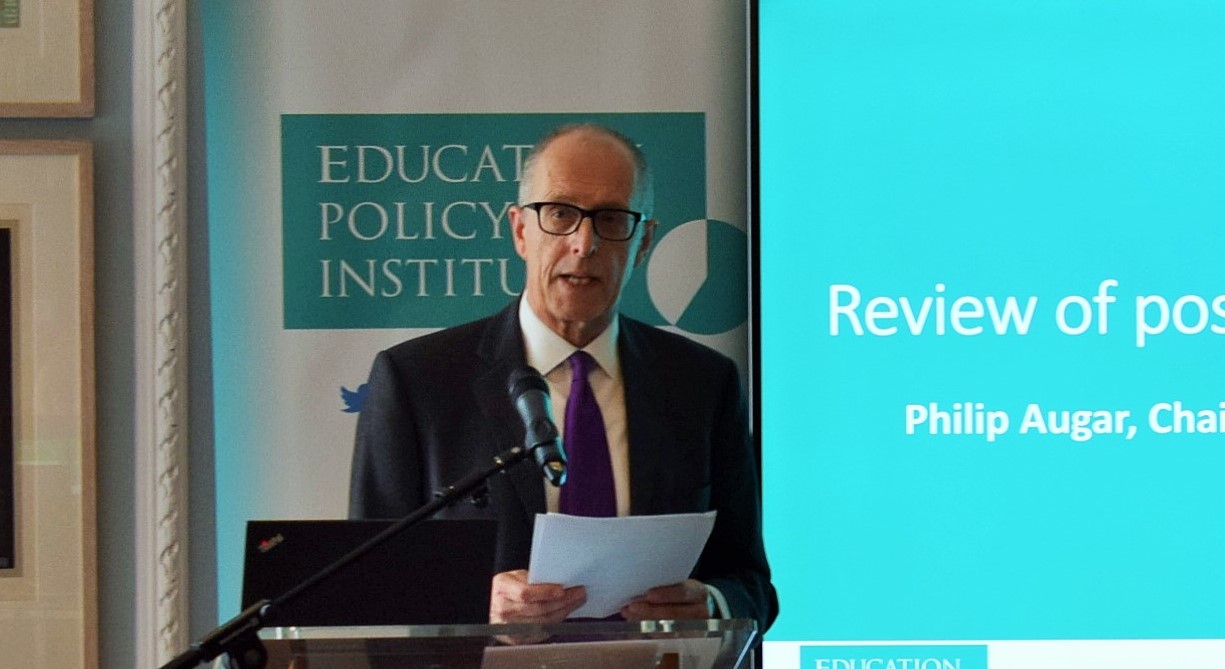
In March 2018 at an EPI conference, Philip Augar launched a call for evidence for the post-18 education and funding review, which he had been asked by the Secretary of State to chair.
Fourteen months later, following much impassioned debate, a great deal of speculation, and a series of leaks, the panel finally published its recommendations for the government.
Just three weeks before the panel’s report was published on the 30th May, we set out our own proposals the various policy options under consideration in the review. So how do the panel’s recommendations stack up against our own?
Firstly, the areas of broad agreement:
EPI recommendation: Any reduction in tuition fees should be at least partially offset by increasing teaching grants, with priority given to grants for high-cost subjects, and the government should rule out creating a variable fee system.
The panel recommended cutting tuition fees to £7,500 offset by an increase in teaching grants that more accurately reflect subject costs and its social and economic value. Although much of the attention here will go on the impact on the debt and contributions of graduates, equally important is the fact that this change will allow the government to redress the perverse incentives within the current system for universities to recruit on the basis of profit margins rather than labour market demand. This is a positive step.
EPI recommendation: A UCAS tariff floor should not be introduced without robust evidence that a significant majority of those affected would be better off pursuing alternative education or training pathways.
On the much-debated policy of imposing a minimum academic standard to access university loans, the panel recommends a hiatus on such a ‘tariff floor’, in order to give the sector a chance to improve the poor labour market outcomes for the young people who might be affected by such a floor. We agree with this approach. But in the event that it is unsuccessful, the government must present clear evidence that the outcomes for these young people would be improved by pursuing alternative education or training pathways before introducing a tariff floor.
EPI recommendation: The government should introduce further ELQ exemptions in fields of study with high returns or strong labour market demand.
Equivalent and Lower Qualification (ELQ) restrictions prevent those looking to study at a level at or below which they are already qualified, from accessing student loans – deterring any reskilling later in life. Here the panel went further than our proposal and recommended the complete abolition of ELQ rules. However, this went hand-in-hand with the introduction of a single lifelong learning loan for those doing level 4 and 5 qualifications in further education, equivalent to 4 years full time undergraduate study. These changes are likely to see a shift from graduates taking a second bachelor’s degree in a STEM subject to graduates taking a subsequent level 4/5 qualification in a wider range of qualifications. Whilst these level 4/5 qualifications must meet a set of employer-led standards, there is a risk that the additional qualifications taken by graduates meet personal, rather than labour market needs, and at substantial costs to taxpayers. If the government adopts this proposal it must carefully monitor the uptake of qualifications taken by graduates, and consider reintroducing some subject restrictions to ensure alignment with labour market demands.
EPI recommendation: The government should be clear on the distributional impact of its proposed changes to the student loan terms and should publish a detailed assessment alongside the review recommendations.
The panel did indeed publish the distributional impact of the changes to the loan terms. What it shows is that the loan terms remain broadly progressive, but less so than the current system. High earning graduates are the main beneficiaries of the proposed changes, mainly because their total repayments would be capped at 1.2 times the original loan amount, reducing their net contribution. More immediately concerning is the corresponding increase in the contributions of middle earners. Due to the reduction of the repayment threshold and increase to the repayment period these graduates will make increased lifetime contributions, and more of them will pay off their loan completely before it is written off.
However, two things should be borne in mind. Firstly, although it is middle earning graduates that are hardest hit, we must remember that these middle earning graduates are not middle earners in the labour market as a whole. Female graduates earn 50 per cent more at age 29 and male graduates earn 25 per cent more, than non-graduates. As such it is actually those graduates with just above average earnings (in terms of the whole population) who are hardest hit.
Secondly and more significantly, we must consider the distributional impact of the whole package of recommendations. Specifically, the additional £0.7bn that is targeted at further education, where learners are more likely to be from disadvantaged backgrounds. If these recommendations are adopted, the package creates a system that is mostly progressive, with changes that benefit high earners and those from more disadvantaged backgrounds, with those graduates with just above average earnings picking up the tab.